Over the past few decades, the global investment industry operated under a beautifully simple, mathematically elegant directive: allocate capital where expected risk-adjusted returns appear the highest. Capital chased growth, yield, and alpha across a highly integrated, frictionless macroeconomic landscape. But beneath the surface of today’s mainstream financial headlines—which remain obsessively fixated on central bank rate cuts, quarterly corporate earnings surprises, or the speculative froth surrounding generative Artificial Intelligence (AI)—a quiet, profound structural transformation is taking place.
The world’s most sophisticated private pools of capital are systematically archiving the old playbook. The defining story of macro wealth strategy today is not what family offices are buying, but why their institutional behavior is fundamentally changing.
A consensus has emerged across recent flagship private wealth intelligence reports—including the UBS Global Family Office Report, the Bank of America Family Office Study, and the RBC / Campden Wealth Research Series. The data confirms a seismic shift: the world’s largest family offices are migrating away from raw return maximization and aggressively moving toward systemic resilience. Approximately 60% of global family offices are currently reviewing or actively overhauling their Strategic Asset Allocations (SAA).
When the majority of the world’s most patient capital collectively decides to rewrite its long-term investment blueprints simultaneously, it implies something far greater than ordinary market anxiety. It signifies a fundamental reassessment of the structural environment in which those portfolios must survive. As an independent analyst observing these capital flows, it is clear we are witnessing a historic transition from an era defined by growth to one defined by longevity.
⏳ The Generational Lens: Transforming the Definition of Risk
To understand this behavioral shift, one must first recognize the structural advantage that separates family offices from traditional institutional asset managers, hedge funds, or publicly traded corporations: an elongated time horizon.
While a public company executive answers to the next 90 days of quarterly earnings and an institutional fund manager is judged by an annual relative benchmark, a family office evaluates performance across decades and multiple generations. When an investment mandate spans forty, sixty, or one hundred years into the future, the very definition of risk undergoes a profound transmutation. Short-term volatility becomes mere noise; structural institutional collapse, systemic inflation, and wealth erosion become the true variables to mitigate.
In a multi-generational framework, macro threats cease to be abstract academic exercises. Historical data proves that wealth is highly fragile over long arcs of time. The focus of the world’s most sophisticated allocators has shifted from asking “Where can capital grow the fastest?” to a far more demanding question: “How can this capital, and the opportunity it represents, survive intact across the fractures of the next half-century?”
🌍 The Triple Threat: Sovereign Debt, Fiscal Volatility, and Jurisdictional Firewalls
What specific structural shifts are driving this flight to resilience? The primary catalyst is a growing institutional anxiety surrounding sovereign debt, structural fiscal deficits, and long-term fiscal sustainability within developed economies.
Years of aggressive quantitative easing, combined with historic post-pandemic fiscal spending, have left major G7 economies saddled with debt-to-GDP ratios not witnessed since the aftermath of the Second World War. With structural deficits projected to expand further due to aging demographics, defense spending re-industrialization, and global energy transitions, family offices are realizing that governments face a constrained box of options: inflation, financial repression, or aggressive tax hikes.
Consequently, the concept of diversification has fundamentally evolved. It is no longer sufficient to simply balance public equities, fixed income, and private alternative assets within a single domestic framework. Today, the leading family offices are executing sophisticated strategies centered around jurisdictional diversification. True diversification in this fragmented era requires deliberate operational distribution across disparate legal systems, regulatory environments, currencies, and physical geographies.
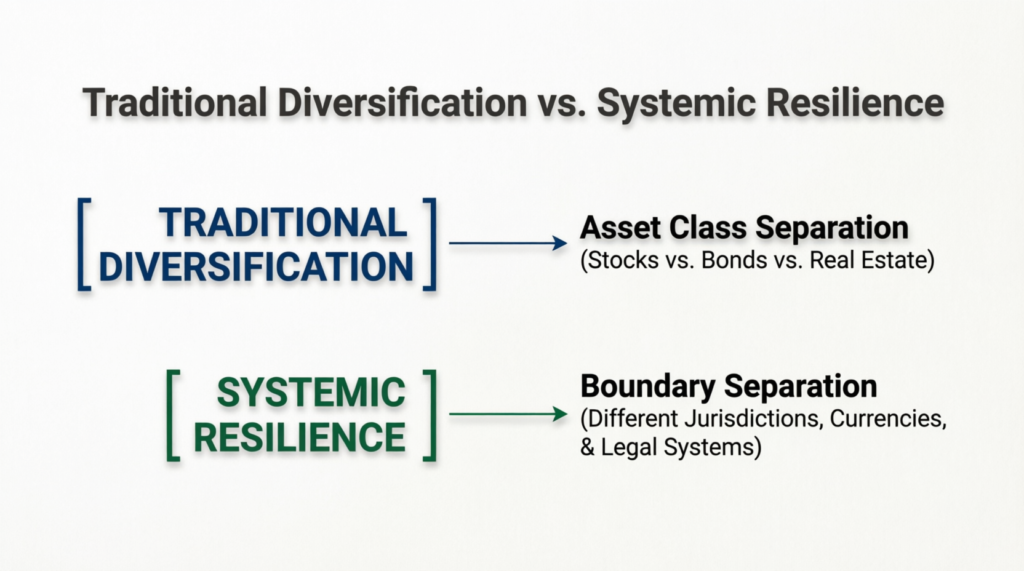
There is an accelerated trend of family offices establishing secondary and tertiary institutional hubs in neutral, highly stable jurisdictions like Switzerland, Singapore, and the United Arab Emirates. By segregating custody, corporate structures, and physical residency across multiple sovereign states, these entities create built-in operational firewalls. If one jurisdiction experiences acute fiscal distress, political instability, or punitive regulatory shifts, the broader multi-generational corpus of wealth remains isolated and operational elsewhere.
🤖 The Tactical Shift: Hard Assets, Infrastructure, and Private Credit
The quest for resilience is vividly reflected in asset allocation data. The “Resilience Portfolio” looks starkly different from the speculative “Growth Portfolio” of the previous decade.
- The Renaissance of Tangible Wealth: Real, tangible assets are regaining institutional favor as a hedge against fiat currency debasement. While allocations to physical gold remain structurally modest, the directional shift is highly significant as a tool to reduce pure fiat currency exposure.
- Infrastructure and AI Supply Chains: While general commercial real estate exposure is being pared back due to structural shifts in hybrid work and urban dynamics, capital is pouring into infrastructure. Family offices are heavily favoring the physical supply chains powering the digital economy—investing in private data centers, localized energy grids, and semiconductor supply chains. They are favoring the “picks and shovels” of the technological revolution over speculative software bets.
- The Ascent of Private Credit: In the void left by traditional commercial banks retreating from mid-market lending due to tighter regulatory constraints, family offices have stepped in as direct lenders. Private credit and direct lending structures allow these entities to capture substantial illiquidity premiums while securing senior-secured positions in the capital stack, providing both defensive protection and predictable cash flows.
👨👩👧👦 The Invisible Architecture: Internal Governance as the Ultimate Risk Metric
Perhaps the most critical and overlooked insight buried within recent family office research has nothing to do with capital markets, asset classes, or macroeconomic indicators at all. It concerns the internal architecture of the family itself: governance.
Empirical data consistently demonstrates that investment mistakes or market downturns are rarely the primary executioners of multi-generational fortunes. Instead, the historical erosion of concentrated wealth—the classic “wealth gained and lost in three generations” phenomenon—is almost universally driven by internal structural failures: poor communication, unresolved familial friction, and a lack of structured succession planning.
Recognizing this internal vulnerability, progressive family offices are dedicating unprecedented capital and institutional resources to family governance, formal constitution drafting, and comprehensive next-generation education.
| Governance Metric | Current Reality | Strategic Objective |
| Succession Planning | Only a minority have formal, written succession plans for leadership transitions. | Institutionalizing leadership roles to eliminate single-point-of-failure risks. |
| Next-Gen Readiness | High anxiety regarding the psychological weight and preparedness of heirs. | Implementing mandatory structured family education and financial stewardship programs. |
| Operational Automation | Historical reliance on manual processes and disparate spreadsheets. | Migrating to automated data aggregation, AI reporting, and unified risk dashboards to eliminate operational friction. |
It is an operational realization that an investment portfolio is only as resilient as the human system managing it. Preparing heirs to be stewardship-oriented allocators rather than passive consumers is now viewed as an essential risk-mitigation strategy. Without a robust internal governance framework that defines decision-making protocols and dispute resolution mechanisms, even the most sophisticated jurisdictional asset structure will eventually fail from within.
🏁 Conclusion: The Ultimate Metric of Longevity
When we look at these developments collectively, it becomes clear that the global financial landscape has crossed a structural rubicon. We are leaving a multi-decade era defined by frictionless globalization, low structural inflation, and ultra-cheap debt—an environment where hyper-growth was the natural, default objective. We have entered a new epoch structured around geopolitical fragmentation, fiscal volatility, and institutional realignments.
In this new landscape, resilience is the ultimate luxury, and longevity is the supreme metric of capital success. The wealthiest families in the world are no longer asking only where capital can grow fastest. They are building fortresses designed to endure.
This holds a profound, universal lesson for every serious macroeconomic observer. True wealth is never accurately measured by how much capital is accumulated during a lifetime. It is defined entirely by how much remains protected, productive, and seamlessly transferable long after the original creators are gone. In an era of profound macro uncertainty, resilience is not a defensive retreat; it is the ultimate strategy for long-term survival.