Why Family Dynasties Implode Across Generations—And the Real Fiduciary Role of the Family Office
One of the most profound paradoxes of global wealth is that the greatest threat to a multi-billion-dollar empire is almost never the market itself.
Over decades of tracking royal dynasties, cross-border family conglomerates, and private capital ecosystems, an independent analyst begins to notice a striking pattern: despite vast differences in culture, geography, and industry, the architectural failure points of massive fortunes look eerily identical. The final collapse might look like a sudden, dramatic event—a headline-grabbing lawsuit or a hostile boardroom coup. But in reality, the structural foundation had been quietly rotting from the inside out for decades.
This is precisely where the global financial industry completely misinterprets the real purpose of a family office.
The general public, and even many sophisticated wealth owners, view the family office as a specialized investment boutique designed to chase alpha, optimize tax structures, and build asset shelters. While those technical mechanisms are essential baseline utilities, they only represent the surface layer.
The deeper, far more complex mandate of a true family office is sociological and psychological: to preserve structural stability and absolute operational alignment among emotionally connected people who are collectively carrying staggering amounts of unearned wealth, historical expectation, and legacy responsibility across generations.
When an empire reaches scale, its primary adversary is no longer competitive disruption. It is human nature.
The Relational Math of Destructive Decay
The predictable lifecycle of generational wealth is so cross-culturally consistent that it has birthed nearly identical proverbs across wildly different civilizations. The American phrase “Shirtsleeves to shirtsleeves in three generations” perfectly mirrors the Chinese “Wealth does not pass three generations” (富不过三代), the Scottish “The father buys, the son builds, the grandchild sells,” and the Italian “Dalle stalle alle stelle alle stalle” (from stalls to stars to stalls).
This is not merely historical folklore; it is verified by brutal empirical data.
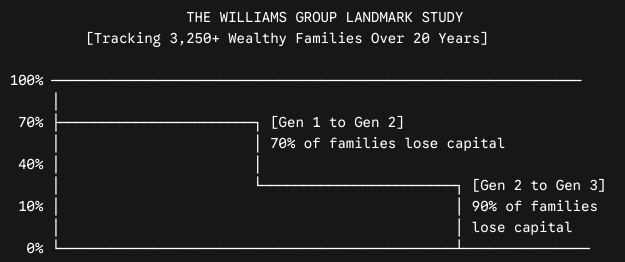
A landmark 20-year study by the Williams Group, which comprehensively tracked over 3,250 wealthy families, revealed that 70% of wealthy families lose their capital by the second generation, and a staggering 90% completely dissipate it by the third.
The most critical revelation of this research lies in why they failed. The study isolated the root causes of generational wealth destruction and discovered a microscopic correlation to traditional financial factors:
- 60% of multi-generational failures were driven directly by a breakdown of communication and trust within the family unit.
- 25% collapsed due to inadequately prepared heirs who lacked the psychological training to handle massive liquidity.
- 12% disappeared due to a lack of a shared family mission or poorly defined values.
- A mere 3% of failures were caused by poor financial planning, tax inefficiencies, legal structuring, or market downturns.
The data forces an uncomfortable conclusion: empires do not fail because of their balance sheets; they fail because of their people.
Act I, II, and III: The Psychological Arc
To prevent this decay, one must understand the psychological evolution of the three-generation arc. It is a human tragedy structurally told in three distinct acts:
Act I: The Founders (The Builders)
Forged in a culture of sacrifice, high risk-tolerance, and raw survival instinct. Their relationship with capital is highly intimate, built through scarcity and relentless execution. To them, money is not an instrument for comfort; it is a scorecard of survival and an engine for the mission.
Act II: The Stewards (The Managers)
Raised in the direct shadow of that sacrifice. They witnessed the grueling hours, the financial anxieties, and the physical toll it took on the founders. Because they saw the wealth being built, they retain an intellectual and emotional bridge to the operating business. They view themselves as caretakers bound by duty.
Act III: The Consumers (The Heirs)
Born into an entirely detached reality. They inherit clean liquidity, immense optionality, and an insular ecosystem of total safety. They have never seen a payroll they couldn’t meet, or a bank line of credit frozen. If personal discipline, accountability, and emotional maturity are not intentionally institutionalized, they mistake the balance sheet for the legacy, consuming the capital without understanding the cultural machinery required to generate it.
The Strategic Fragmentation of a Shared Mission
As time moves forward, a family inevitably expands from a tightly knit nucleus of founders into an exponential matrix of cousins, in-laws, and far-flung branches. As the human element multiplies, the architecture of shared purpose naturally degrades.
This is the point where the family enterprise reaches its highest level of systemic vulnerability. Different family members begin demanding entirely conflicting outcomes from the exact same asset base at the exact same time:
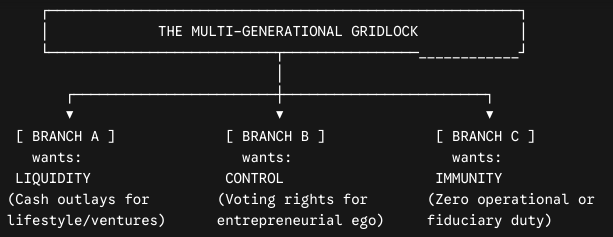
Without an overarching governance mechanism, the corporate balance sheet ceases to be a commercial instrument driving an economic objective. Instead, it becomes an emotional proxy arena. Unresolved childhood rivalries, perceived generational slights, and psychological validation loops begin expressing themselves through high-stakes financial liquidation requests, strategic vetoes, and legal standoffs.
The Trillion-Dollar Transition Risk
Data explicitly underscores the macroeconomic cost of failing to manage these human dynamics. Extensive global research tracking corporate leadership transitions reveals that poorly managed chief executive successions destroy an estimated $1 trillion in global market value annually.
Conversely, when family business transitions are executed correctly, the upside is immense. Studies show that well-managed internal family transitions generate a 23-percentage-point improvement in shareholder returns—nearly double the gain seen when an enterprise brings in outside executives.
The operational lesson is absolute: the upside of managing the human element correctly is astronomical, but the cost of leaving a relational blind spot unmanaged is total liquidation.
Architecture of the Modern Sovereign Family Office
Historically, family offices operated as glorified investment silos. However, modern family office architecture—frequently highlighted in global research by bodies like Campden Wealth and UBS—has shifted radically away from pure stock-picking toward a holistic, institutional governance paradigm.
To protect an empire against generational erosion, the family office must actively design, build, and maintain an internal scaffolding resting on four core pillars:
1. Structural Family Governance Frameworks
The implementation of formal, legally binding frameworks that dictate how the family interacts with the operating assets and the capital pool. This requires drafting an explicit Family Constitution, establishing an independent Family Council entirely distinct from the commercial board of directors, and creating transparent, non-negotiable rules for how heirs can—and cannot—enter or exit the family ecosystem. It replaces emotional assumptions with institutional certainty.
2. Moving Heirs from “Informing” to “Involving”
The rising generation must be given a stake, not just a dividend check. Long-term sustainable families give heirs real, bounded operational authority over specific mandates—such as managing a ring-fenced venture fund, heading an internal technology/AI transformation unit, or spearheading a structured philanthropy initiative. This must be backed by strict external professional requirements, creating a culture of meritocracy rather than unearned handouts.
3. Implementing Reverse Mentorship
True structural alignment requires breaking down generational insulation. While senior leaders pass down foundational wisdom and legacy values, the rising generation must actively mentor the founders on artificial intelligence, shifting global cultural paradigms, and emerging digital asset ecosystems. This structures mutual intellectual respect across generations and protects the broader portfolio from becoming obsolete.
4. Treating Succession as a 10-Year Process
Most founders plan to “die with their boots on,” a psychological disposition that almost guarantees operational chaos. Structural succession is never a single transactional event or a signature on a trust document. It is a gradual, decade-long transfer of institutional relationships, strategic wisdom, and ultimate authority.
Capital as an Acceleration of Human Behavior
Ultimately, wealth is a verb, not a noun. It is a dynamic system of human interactions, and capital is merely a massive amplifier of whatever behavior already exists within that system.
If a family structure is internally resilient, grounded in deep individual accountability, and anchored by robust institutional governance, capital serves as a spectacular catalyst for global innovation, continuous impact, and multi-generational stability. But if the internal family structure is fragile, uncoordinated, and fractured by unspoken resentment, an influx of unearned capital does not act as a shield—it accelerates their ultimate collapse.
The family office must be recognized for what it truly is: the guardian of the family’s psychology. It must be structurally designed to break internal silences, professionally equipped to navigate emotional chaos, and wise enough to know that while the balance sheet is merely a report card of past performance, the structural family meeting is the only true predictor of the future.
If an empire fails to manage its emotional and behavioral risks, the market will not kill it—its own creators will.